Be sure to subscribe so you don't miss a thing. You can subscribe via email. or rss feed. Or join me on Facebook or Twitter o4 follow me on Pinterest
Showing posts with label Natural Cleaners. Show all posts

Wednesday, May 30, 2012

The Problem with the Smell of Clean


IMG_3153-1


What does clean smell like? Ask most people and they will tell you it smells like lemons, or spring rain, fresh air, or  clothes dried on the clothes line.  but many of these so called “scents”  are artificial fragrances Manufacturer’s of cleaning products know and understand this too. Why do you think they allude to these scents in their products and advertising?  Many cleaning products have added fragrance.  Many fragrances are made up of a complex cocktail of natural scents and synthetic chemicals, many of these are petrochemicals. Even many so called green cleaning products are not really all that green.
Why do manufactures add fragrance? Fragrance is a key component to cleaning products – as it is often what distinguishes one product from another, and what creates brand loyalty. Companies take great measures to ensure that the fragrance is experienced fully by the user. Our sense of smell is one of strongest and we associate memories with certain smells,  Chemists, manufacturers and product companies know this.  If something does not smell clean how will we know that it is clean? Once a upon a time ago my husband helped a friend with a cleaning business. They cleaned with vinegar but before leaving a place they would spray in the air a little bit of Pine Sol. . Yup it was just so that there was the ‘smell” of clean. They got more referrals and compliments when they sprayed the bathrooms for the smell. The clients thought if it smelled clean then it was truly clean. 
The scents added to cleaners do not enhance the cleaning ability of most cleaners. Quite the contrary many fragrances can cause more harm than good.   Among the chemicals that are used to produce fragrance are chemicals associated with hormone disruption and allergic reactions.  Also in the ranks of undisclosed ingredients are chemicals with troubling hazardous properties or with a propensity to accumulate in human tissues. These include diethyl phthalate, a chemical found in 97 percent of Americans (Silva 2004) and linked to sperm damage in human epidemiological studies (Swan 2008)
Currently the United States does not require manufacturers to disclose the ingredients in fragrances, including the fragrances in cleaners, as this is considered proprietary information.
What can you do if you want to avoid chemical  fragrances that can cause problems ranging from allergies to cancer? 

  • Make your Own Cleaners – personally if it is not safe enough to put use on  my body I will not use it in my house.
  • Check out EWG they will soon be coming out with a data base of Cleaners but for now they have a Hall of Shame List for Cleaners, check it out make sure none of yours are on here. Surprisingly some  so called “green” cleaners are on here.
  • Use Alternatives for Chlorine in Cleaning

For More Reading.
Dirty Secrets - What's hiding in Your Cleaning Products
Physicians for Social Responsibility
EWG  Cleaners Hall of Shame

Tell me do you have a favorite Cleaner you like to use? It is safe?


this post is linked up with Your Green Resource

Monday, March 19, 2012

10 Ways to a Greener Spring Cleaning


16th century laundry


Something about Spring Break makes me want to clean. I know it is a little weird but since we usually don’t go away for Spring Break I take advantage of some deep cleaning. But around here I don’t break out the bleach or other harsh cleaners. We like to keep it green.


  1. Make your own cleaners for pennies on the dollar. My favorite is a simple formula.All you need is a simple empty spray bottle. a little water, distilled vinegar and some teat tree oil.

  2. Use Cloth Rags – You don’t have to go out and break the bank buying new rags.  For cleaning any old rag will do, orphan socks, old t-shirts, clothes that don’t’ fit kids anymore.

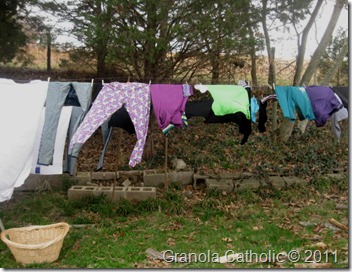
  3. Hang up your clothes outside. Use a clothesline if you can. Clotheslines have the multiple benefits, one being using less energy the other being that the sun helps to bleach and sanitize your clothes. Personally my favorite reason to use it is the smell of the clothes.

  4. Take your shoes off at the door, If you feel you must wear shoes inside have house shoes.. We track in everything we walk through, When you make it a habit to keep your shoes at the door you do not track toxins through the house.

  5. Hydrogen Peroxide makes a great sanitizer and stain remover. Dilute it in a spray bottle, one half water to one half hydrogen peroxide. Since it is light sensitive make sure it is kept in a dark (opaque) spray bottle. I like to keep one bottle in the kitchen and one in the bathroom. Come to think of it one in the laundry room would be a good idea.

  6. Find a new home for all those plastic cups you have. We all have a cupboard full of plastic cups, they are cheap, sometimes free. Plastic contains BPA. Not only that, if you use it to heat food up in the microwave, the scratched plastic can leak chemicals into your food.

  7. Dispose of  toxic cleaners in a safe way. Don’t’ be tempted to just throw away the chemicals cleaners you were using. . You must be careful when disposing of these chemicals. Not only are they toxic and dangerous but mixing them makes them a toxic soup.  Check your local area for a collection day.  Many states, cities and counties have local collection days for hazardous household waste. If you are lucky there is a spring collection day.

  8. Open the windows, and skip the air fresheners. Nothing cleans out a stale house and freshens it up like fresh air. If you feel you must use some scent place some essential oils in a spray bottle and spritz that around the house.

  9. Skip the antibacterial soap. Not only will regular soap and water do the trick did you know that the main ingredient in anti-bacterial soap, tricolsan is in reality an insecticide? You wouldn’t use a pesticide on yourself or kids would you? Then why use one in your house?

  10. Take my husband’s advice and if the weather is good, just get outside and take a break from cleaning. The fresh air will do YOU some good.
linked up to Live Renewed Spring Cleaning, Green and Natural Mother's Blog Hop, Simple Lives Thursday

Sunday, February 26, 2012

Is There Chocolate in Your Hair?


unsweetened_cocoa

Regular readers probably already know that I use a no-poo method of washing my hair. Most of the time this is namely the Baking Soda ACV method.  But on those mornings I am running behind and think I can push the hair one more day I have a trick.
You may have already guessed what that trick is from the tittle. But you may be wondering how I use chocolate in my hair. I will take some cocoa powder and put it on a bristle brush and then brush it through my hair. Not only does the cocoa absorb the oils in my hair it gives my hair a nice red tint (well at least the white hairs). Someone will comment on my hair and wonder if I have colored it recently.
Why Use Cocoa Powder?
Cocoa is full of anti-oxidants, they are still there in the powder form, The anti oxidants are good for your hair too.  Cocoa is also high in magnesium, a nutrient missing or sorely lacking in most of our diets. Remember what you put on your body does end up in your body.
If you want to go further Crunchy Betty has a great hair mask treatment recipe using cocoa and yogurt. I just might have to give this a try.
Have you tried any interesting things in your hair lately? Let us know how they work here.

Monday, January 23, 2012

Cleaning Gardener’s Hands


dirty_hands
image credit
What to do when your Hands Look Dirty Like This
I am an avid gardener, both vegetable and flower beds. One consequence of this avocation is that my hands dry out easily, they are in dirt a lot and with the constant washing it tends to dry them out more. Over the years I have tried a variety of things to alleviate this dryness and rid myself of the ground in dirt that seems to be constant on my hands. Some of these remedies work better than others but I bet they include things already i n your home.
  • A little liquid soap. I will coat my hands with a little liquid soap, like Castile Soap, but a non-allergic liquid dish soap would work well too. When I started doing this I noticed that it not only made my hands easier to clean because the dirt was on top of the soap, it helped to cut down on the contact dermatitis.
  • Olive oil and honey. I like to use this after I come in from gardening after rinsing the castile soap and dirt off my hands I will continue to wash them with a mixture of 50% olive oil 50% honey. The oil helps to emolliate and cleanse at the same time, while the honey helps to clean, act as an antibacterial and  humectant, thus sealing in the moisture.
  • An olive oil sea salt scrub, I just mix a little olive oil and sea salt on my hands and work it in, rinse off when you feel you have removed the dirt. Alternatively you can use oatmeal or brown sugar to scrub with.

I tend to open my cupboard and see what is readily available to scrub my hands with. It is not too important to me what I use as long as it is something I would eat it is safe for my skin.
Remember DON’T PUT ANYTHING ON YOUR BODY YOU WOULD NOT PUT IN YOUR BODY!


How do you like to get your hands clean after working in the garden?

this post is linked up with Seasonal Celebrations at Natural Mothers Network, Homestead Blog Hop

Monday, October 3, 2011

Alternatives to Chlorine Bleach for Cleaning


no_bleach1

Reasons not to Use Bleach for Cleaning
  • It is caustic and when mixed with other cleaners, such as ammonia it produces a toxic gas. In fact chlorine gas is so caustic it has been used in chemical warfare from WW I to Vietnam to the Iraqi War
  • It deteriorates your clothing, eating away at the fibers
  • Chlorine loses its effectiveness in just the first 90 days inside a never opened jug or container. Chlorine constantly escapes through the plastic walls of its containers.
  • Chlorine is a key component of DIOXIN.  One of the earliest findings of dioxin's toxicity in animals was that it caused birth defects in mice at very low levels. This finding led to dioxin being characterized as "one of the most potent teratogenic environmental
    agents"
    . The first evidence that dioxin causes cancer came from several animal studies completed in the late 1970's.
What are our Alternatives to Bleach for Cleaning?
There are many alternatives to bleach when cleaning. So many of them are versatile and can be used for more than just laundry too. There are safer alternatives such as borax or vinegar which don't produce dangerous fumes or leave behind toxic residue. For these reasons try to avoid using bleach and if you must use it, only use it on non-porous surfaces.
Borax
Borax can be used as a deodorizer as well as to cleaning toilets and drains. Borax is also used as an insecticide, herbicide and fungicide and it can be mixed with water in a solution to kill and remove mold as it is a natural mold inhibitor. Borax is found in the laundry aisle and is cost effective too.  I personally use this in my laundry, but the more I learn about it the more versatile it is. Last spring we had plenty of rain and it caused mold growth in our basement. We used diluted bleach but we were not able to work for long. I have since found out that the bleach does not penetrate the sheet rock, so the roots regrow again. Now I know why the mold came back. Next time we get a mold bloom I will be sure to use Borax.

 Vinegar

Vinegar is a mild acid and is even effective at killing l 82% of mold species. It has a long history of use as an antiseptic but has the the advantages of being natural and safe. Vinegar is non-toxic and doesn't give off dangerous fumes like more caustic bleach. It is strong enough to be used to clean my counters, yet gentle enough to be used in my hair.  Back in the so called dark days of medicine, the medieval ages, vinegar was used as the primary antiseptic. 

Hydrogen Peroxide
Before last week I never considered using Hydrogen Peroxide for cleaning, but I happened upon this post on Stacey Makes Cents has a post about cleaning with it, and I ran across another post here on using hydrogen peroxide for cleaning. When you think of it it makes sense in more ways than one. Oxy Clean and other oxygen cleaners are basically hydrogen peroxide. We use hydrogen peroxide to clean our wounds. So why not use it to clean our houses? It is safe enough to use on our food and surfaces where we prepare food yet it is effective enough to kill mold, mildew, bacteria and

Baking Soda
Baking soda is one of my go –to cleaners. It makes a great abrasive when you need to scrub things. Baking soda is great for deodorizing too.  When the laundry is particularly stinky I will add some baking soda to it.  I use it regularly in my toilets and in scrubbing porcelain sinks, even though it is abrasive it is fairly mild too.

Tea Tree Oil
I could rasp poetically about tea tree oil.  I include it in my homemade cleaners Tea tree oil is an essential oil which is harmless to people and pets. Tea tree oil is antifungal, capable of killing all types of molds. Tea tree oil is antibacterial as well. I make sure to put some in stinky loads of laundry or on stinky pets. Who are usually stinky from rolling in something dead. Kill those microbes.
You can buy tea tree oil for about $10 for a small bottle from most natural food stores. Make sure the tea tree oil you buy is derived from the Melaleuca Alternifolia, which is the technical name for tea tree, as not all brands always are.

The Sun
When it comes to laundry and your whites, the sun is one of the best bleaching agents ever. It miraculously  gets your diapers and towels clean. That with a little vinegar in my washing machine do the trick.  If you don't believe me about the sun's bleaching effects try this experiment. Take a piece of construction paper and lay a leaf on it in the sun, come back a few hours later and remove the leaf. This is an age old tradition of sun printing.

What is your favorite bleach alternative?

Technorati Tags: ,

Linked up with Living Well Blog Hop

Sunday, October 2, 2011

Monday–Green Wash Day


IMG_3153-1

The old poem goes
Monday: Wash Day
Tuesday: Ironing
Day…..

While the modern household still finds laundry to be a chore, Mt. Washmore, anyone? Laundry was more of a chore before the advent of washing machines. But today we have soo much help in the laundry department. It may seem that we are never on top of the chore but we can make it more green.
How can we make our Laundry Day more Green?
  1. Wash your clothes in cold water. Going A Green Family has a great post of our addiction to hot water washing. When she was in a microbiology student the discovered that It wasn’t the hot water that killed icky stuff. The biggest difference was from length of agitation (i.e. scrubbing time) and type of soap. Also, keep in mind that science says that unless hot water is too hot to touch, no way will it sanitize. I’ve touched the hot water coming from my washing machine before and it certainly didn’t burn me. It’s just not that hot. If it’s not that hot, it’s not sanitizing, it’s just wasting energy and your money. Today many detergents are formulated to work perfectly fine in cold water.  I wash my whites in cold even,
  2. Line dry your clothes. When the weather is nice I line dry outside when it is not I line dry inside. Line drying saves your clothing. Do you know where lint comes from? It comes from your clothes. Line drying is less abrasive to your clothes and helps to prolong the life of your clothes. Not only that the dryer is one of the biggest energy hogs in your house.
  3. Switch to a more eco friendly laundry soap, Grist has a review of some on its site.
  4. Make your own laundry soap.  I personally use a mixture of Castille Soap, Borax and Washing Soda, and because castille soap is concentrated I only use a couple of tablespoons.
  5. Consider trying Soap Nuts
  6. Ditch the scented dryer sheets. Most of these are artificially scented, these scents have phthalates in them.  In a nutshell phthalates are chemical hormone disrupters. If you want your laundry to smell better use some essential oils on a wet cloth in the dryer, or straight into the washing machine. I like to use tea tree oil for its antiseptic properties and lavender, both for the wonderful scent and its traditional use in laundry.
  7. Add some vinegar to your rinse cycle. It helps cut the soap in your clothes, making them softer when you line dry them. Trust me, if you even hang up towels outside they get stiff, add some vinegar to the rinse cycle and they are no longer stiff.
  8. To get stains out use an oxygen cleaner. These are essentially hydrogen peroxide, so dilute it in a spray bottle.
  9. Wear clothes more than once. Jeans can be worn multiple times before washing. same for dress clothes, simply hang the up when you take them off to air out.
  10. Avoid Chlorine Bleach. Seriously, this is stuff is bad. Do you know it was one of the ingredients in agent orange? I bet you do know that you should never mix it with ammonia. There are alternatives to chlorine bleach, oxygen cleaners like Oxy clean work every well.


Technorati Tags: ,

Sunday, September 4, 2011

E–Book Review and Give Away

This give away is now closed. Thanks to Everyone who participated. 


Regular readers of my blog know that I am a fan of natural cleaners. I have been making my own for years.  I started with just simple white vinegar when I first got married. It really helped me to get over some allergy and auto-immune issues I tend to have.

Even though I have been making my own cleaners for years, I am always looking for ways to improve them. How can I make them better, easier? So when Jenny at the Peaceful Housewife asked me if I wanted to review her new e-book I said sure.  I would just like to add that Jenny was one of the first people I linked up with when I started blogging for earnest this year. Even though we have not met IRL she is a local peep to me. Maybe one of these days our schedules will synch up.
First of all what I love about Jenny’s recipes for cleaners is that she uses ingredients you are likely to already have in your home, and if not, they are readily available at your local store. For example her furniture polish is simply olive oil and lemon juice.  My house smells good just mixing it up. If I have any left I can make my homemade vinaigrette with it. Jenny has included many recipes for the modern home, granite cleaner,  wet mop refill cleaner, stain remover, even a gel stain stick. Have I mentioned how much I miss my stain sticks?
Now I know that not everyone is a DYI sort of person like me. So if you would rather, Jenny has products available for sale on her website. The Peaceful Housewife.  All of her products come unscented or in your choice of scents, with the exception of their  Multipurpose Cleaning Spray and Glass Cleaner.  Those two items do not come custom-scented because the essential oils that we’ve chosen to use in them are part of what makes them work so well.
For those who are more adventurous and would like to try their own hand at making cleaners. I am giving away 2 copies of the e-book. All you have to do is  go on over to The Peaceful Housewife look at her scents and them come back here and tell me what scent you would love to try in your house.  This giveaway will be open until  9am Friday,  September 9, 2011.  I will be using Random.org to determine the results of the winner. Good Luck.

Monday, August 29, 2011

Avoiding Triclosan–or is this toothpaste bad for me?


photo credit
Just yesterday my dh yelled from the bathroom. “ Does this tooth paste have the stuff you wrote about the other day?” When he showed me the package I realized that yes it did have triclosan.  It seems that even in a green home we can find ourselves with less than desirable products. The more we learn about living green the more we can decide where to make our choices. For me avoiding toxins is very important. We have a strong history of cancer on both sides of the family. I am hoping that by avoiding toxins as much as we can possibly and eating as healthily as we can we can give ourselves and our children a fighting chance against our genetic dispositions.
 So How do We Avoid Tricolsan?
Choose bar soaps — triclosan was found in 76 per cent of liquid soaps and only 29 per cent of bar soaps in the U.S. (American Journal of Infection Control, 2002). I actually prefer bar soaps. Be sure to use a soap dish that allows the soap to drain and dry. 
When shopping for products look for and avoid the words Microban. Microban is  a formulation that uses triclosan and it has been added to products such as cutting boards, and diaper bags.
Check your toothpaste, most do not have triclosan in them but Total formula’s do, i.e. Colgate Total.
Avoid dish soaps that are antibacterial. The antibacterial aspect is not necessary and it may harm you in the long run.
Check your deodorant. Some use triclosan to kill the bacteria that cause the smell.  Even many natural brands, such as Arm & Hammer Essentials Natural Deodorant contain triclosan.
Check out the Environmental Working Group to find out what’s in your cosmetic products.
Read your labels, many common everyday household products contain triclosan. Sometimes triclosan is not listed as an active ingredient, it is added to increase shelf life. If the product advertises itself as antibacterial it probably has triclosan in it.
I did some searching to see if I could come up with some brands that specifically do not contain triclosan. I wanted to make shopping easier for me and you.  I found a few brands that do not contain triclosan
According to The Daily Green  there are a few brands that don't contain triclosan. I was pleasantly surprised to see brands that are readily available. Like Toms of Maine, Ivory, Listerine, and Purell and one of my favorite all around products. Dr. Bronner’s Magic Soaps.
Avoiding triclosan and other undesirable chemicals is not as daunting as it sounds. Stick to basic products that are designed to be simple. Remember that old adage about food? “if you can’t pronounce the ingredients you should not eat it? The same holds true for using a product on your body or in your home.”
I  like to keep things easy and not try to remember too many things. But for those of you who like more information I am including links to products that do NOT contain triclosan as well as to products that DO contain triclosan.
Some brands that DO contain triclosan can be found over at Grinning Planet.
For a more comprehensive list of products that do NOT contain triclosan head on over to The Daily Green

Monday, August 22, 2011

Triclosan - Or are Antibacterial Soaps Necessary?

 this post is part of an ongoing series of Toxins to Avoid 

NoTriclosan

Why Triclosan?
So you may be asking yourself, why do you need to concern yourself with triclosan ? With Back to School season here, many schools, pre-schools, and even day cares ask for or use hand sanitizer on a regular basis. Friends of mine are adamant against the use of hand sanitizer. So I decided to look into the reasons behind this one my own.  The FDA and EPA are and have been looking into the safety and the efficacy of the triclosan for several years now.

What is Triclosan?
Surprisingly, at least to me it has been around since 1972, and has become the most widely used antibacterial ingredient in soaps and personal products. It can be particular useful in medical situations. Triclosan is actually a pesticide that is used like antibacterial and antifungal agents. It is similar to antibiotics in many ways  but unlike antibiotics it’s purpose is to stop the transmission of bacteria to a healthy person. Like most antibiotics , does not kill 100% of all bacteria because of this some strains of bacteria end up becoming antibiotic resistant.
Originally, triclosan was developed for use in medical settings, but since 1972, triclosan has been added to a long list of products. According to the CDC  Only a few years ago there were only a few dozen products containing antibacterial agents were being marketed for the home. Now more than 700 are available and it is a $750 million market just in the United States alone. Triclosan is now found in household cleaners, soaps, toothpaste, dishwashing hand lotions, children’s toys and of course hand sanitizers. 
The Problems with Triclosan

  • The most common ailments that we are trying to avoid, the common cold and the flu are viruses. Viruses Do NOT respond to antibacterial  products. Doctors recommend frequent hand washing with soap and water.
  • The dread stomach bug, schools and daycares run rampant with them. We had one strike our house just last week. Most stomach bugs are viral, therefore antibiotic chemicals are no more likely than regular soap to prevent gastrointestinal illnesses. In fact, in one Pakistani study, people who washed their hands with plain soap and water were able to reduce the incidence of childhood diarrhea by 53 percent. Those who used antibiotic soap containing 1.2 percent triclocarban actually experienced slightly higher incidence of illness.
  • Triclosan is toxic to aquatic wildlife. So, the fact that it is in our rivers and lakes means that it is polluting and affecting those ecosystems, and the plant and animal life found there.
  • Triclosan is fat soluble.  Since it has turned up in water supplies it is possible it could turn up in our food chain.
  • Several lab studies have shown that triclosan may alter hormone regulation in laboratory animals.
  • In order for triclosan to work effectively it needs to be left on a surface for about two minutes.  I know that in my family the last time I washed my hands for more than 2 minutes was when my oldest was in the NICU.  I know for a fact that my son does a simple rinse and shake method.  Most people are not this patient, and end up washing off the soap before the antibacterial ingredients can do their job.

Options to Triclosan


Believe it or not,  according to the AMA (American Medical Association) recommends using plain  soap and water.  Hand Sanitizers and Antibacterial soaps are no more effective at preventing common illnesses such as the cold and the flu.  These common ailments are caused by viruses not bacteria. Studies importance-handwashingshow plain soap is as effective as Triclosan. A 2008 meta-analysis of all the experimental studies published in English between 1980 and 2006 on the effectiveness of different hand washing techniques to combat gastrointestinal- and respiratory illness concluded that non-bacterial soap was effective for preventing both gastrointestinal and respiratory illnesses, and that triclosan-containing soaps and wipes had no apparent advantage over plain soap in this regard.

I personally do not use antibiotic soaps at home. My husband and I never bought into the marketing hype behind it. We use a plain soap to wash our hands. When possible I buy a natural soap. Dr. Bronner’s makes a bar as well as liquid soaps.  I know some people are squeamish about bar soap these days but here is the kicker, you don’t even need soap to effectively clean your hands.  Proper Hand Washing Techniques are what clean your hands and rid them of germs.  When we are out and about I will simply use water to wash my hands. If I need to sanitize a cut or scrap we use tea tree oil.

Keeping Your Home Clean Without Chemical Disinfectants


Antibiotic cleaners are not any more effective at reducing illnesses in the home. In fact the CDC recommends against using antibacterial cleaners if anyone in your house suffers from a chronic illness such as asthma, or diabetes. Plain soap is effective in cleaning the house. Up to 20 years ago that is all we had, there were no antibiotic cleaners marketed for the home.
  • Make your own cleaners from vinegar and essential oils. Vinegar has been used since medieval ages when Nuns treating victims of the Bubonic plague would wash their hands with it. These nuns never contracted nor passed on the plague to others. It has a great track record and has been my cleaner of choice since I got married.
  • Combine that vinegar with 3% hydrogen peroxide for more effectiveness.  You will need to put each one in a separate spray bottle and hydrogen peroxide needs to be in a dark opaque bottle so as not to let light into it. I have found bottles like this at the dollar store. Spray the surface with first one than the other.  In tests run at Virginia Polytechnic Institute and State University, pairing the two mists killed virtually all Salmonella, Shigella, and E. coli bacteria on heavily contaminated food and surfaces when used in this fashion, making this spray combination more effective at killing these potentially lethal bacteria than chlorine bleach or any commercially available kitchen cleaner.
    The best results came from using one mist right after the other—it's 10 times more effective than using either spray by itself and more effective than mixing the vinegar and hydrogen peroxide in one sprayer. As an added bonus aside from the health benefits, using this type of natural homemade cleanser is much less expensive than commercial varieties.
  • Sunlight is a great disinfectant. Line drying your clothes will help kill any bacteria left over. Additionally for a heavily soiled load (such as one from kids playing outside or mom gardening), I like to add a little vinegar to the load. Line drying your clothes has so many more benefits than disinfecting too.
My recommendations, use soap and water to wash your hands, using proper hand washing techniques. Put the bar in a soap holder that elevates it so it can thoroughly dry. When away from home and you need to wash your hands simple washing with just water will suffice in most cases. Avoid antibacterial products like the plague. If you do not want to make your own cleaners there are many fine products out there that do not include triclosan or other antibacterial agents.  Check your toothpaste. Most of us do not need triclosan in our toothpastes. Unless your dentist recommends it stay away from tooth pastes such as Colgate Total that contain triclosan. Remember to read your labels.
additional resources
EWG
CDC
Beyond Pesticides
List of products that do not contain Tricolsan

I am sharing this blog post with my good friends over at Green and Natural Mama Thursday

Technorati Tags: ,

Monday, June 27, 2011

Should you Change to A Natural Laundry Detergent?

This post is part of an ongoing series on Avoiding Toxins in our Lives.  To read more on how to avoid toxins click here.


cheer_asile
Have you walked down the laundry detergent aisle lately? I am sure you have, especially if you have children.  They always seem to get dirty or change their clothes a million times a day.  Have you noticed the sheer volume of choices when it comes to laundry detergents? It can be overwhelming.  So why should you reconsider your current laundry detergent? Depending on what you are using there is probably an alternative. I have been researching laundry detergents for the past two month and checking out my alternatives.  Why would I consider changing my laundry detergent to a natural laundry detergent?  I had a laundry detergent that I researched when we moved out to the country. It was good for septic systems and appeared to be natural to boot.  At the time it was GOOD enough for me.  Living out in the boonies, so to speak the closest  big store was about twenty miles away .  While we did have a local store that has a a real butcher still,  it was not suited for the bigger  bulk purchases for things like laundry and cleaning supplies. 
It is hard to say good bye to an old and trustworthy product. It did the  job it was supposed to. But this past April, after  looking around and mulling around the idea of making my own detergent I happened across my neighbors at the Farmer’s Market.  They make soaps and lotions. They had added something new to their product line, concentrated  laundry powder. It was concentrated. It smelled wonderful (lavender), it cost $7 for a little bag about the size of a lunch bag (smaller actually).  My first thought was yikes! I just spent $7 for this tiny bit of detergent. But wait – this detergent was concentrated. I only needed 1-2 tbsp. of it to do laundry.  This little bag of laundry powder lasted as long 3 weeks for me. The biggest box of detergent  I was currently getting lasts me a month. Did I mention we do a lot of laundry here, at least two loads a day?
When the powder was all used up I went back to my regular detergent I had two unopened boxes of it home.  I immediately noticed the chemical fragrance  in my favorite detergent. However, since I had opened the big box I wanted to use it up and not waste it.  But it is then that  I started experiencing an uptick in allergy symptoms, itchy skin, watery eyes.  My frugal side won out and I finished up the box. The second box went back to the store to be exchanged for the supplies to make our own laundry powder.  When my husband saw the list of ingredients on the homemade laundry powder we bought in April he decided that WE could make our own. I took that to mean I would be the one researching the how, buying the raw ingredients, and mixing it up. 

Why should you consider changing your Laundry Detergent?


  • If you or a loved one in your family has sensitive skin, eczema, or psoriasis, you might want to change your detergent.  The chemicals in detergents can irritate your skin, and if you your water is hard or too soft it, you will have detergent residue.


  • Common detergents when used according to the manufacture directions will leave a residue. If you were to rinse your clothes in a washing machine filled with plain water you would see suds when you agitate it.


  • The worst part is most Americans use too much laundry detergent. They simply don’t bother to measure it and just guess. With high efficiency washer this has become more of a problem.  I have been decreasing the amount of detergent I was using steadily to see just how little I could get by with, much to my surprised, I discovered that


  • Soap is not even necessary to wash most loads of laundry, according to Seventh Generation's co-founder, Jeffrey Hollender,  “the agitation of washing machines often does the job on its own.”


  • Many detergents even unscented ones as I found out contain fragrance. This fragrance is usually made up of a synthetic chemical compounds. These chemicals contain xeno-estrogens.  These chemicals like the detergent never completely wash out of our clothing. Our skin is our largest organ, it breathes. We absorb these chemicals through the skin.


  • Many laundry detergents contain phosphates which end up in our rivers and streams. High phosphate levels promote over growth of algae and water weeds


  • We could all use less toxins in our lives.


  • Most laundry detergent are 50% builders by volume. That is right. Unless you are buying a concentrated laundry detergent, you are buying filler. (water) 


  • Perhaps a motivator for many is the high sometimes cost of many laundry detergents. Especially considering you are paying for fillers.


  • This past week I began experimenting with making  my own home made laundry detergent. For now we are mixing it in the washer as it fills with water. Not the  most efficient method but we are having good results so far. We are using a mixture of Washing Soda. Borax and White Vinegar.  I have seen a reduction in my allergy symptoms and hope to continue to see more reduction as we get all traces of detergents out of our laundry. In this up coming week I will be running some experiments to see what combinations  or cleansers work the best and will share with you my results.

    For now I am off to do laundry.


    IMG_3150

    Sunday, June 12, 2011

    My Favorite uses for Vinegar in the Home

    It goes without saying that vinegar may be used in cooking and salad dressings but my dear friend there are soo many more uses for it and the longer I use vinegar the more ways I find to use it.  The mere fact that it is safe to use on all surfaces makes a difference. I use vinegar everyday in cleaning here.

    IMG_4529


    (yes I have an ugly toilet)
    • Cleaning Toilets- one of my favorite uses – use with a little baking soda for some natural scrubbing action.
    • Add to Laundry – Vinegar has mild bleaching properties, it is also antiseptic. But did you know that if  you add it to your laundry it also acts like a fabric softener?  If you line dry your clothes then after rinsing with vinegar they will not be stiff. Vinegar also will remove any detergent residue from your clothing.
    • Clean the Windows- put a little in a spray bottle, use straight for really dirty windows or dilute with water.
    • Make your Own Natural Cleaner -
    • Clean Your Teapot or Coffee Maker – pour about a cup in your coffee maker add enough water to run a cycle.
    • Wash the Floor  - Distilled white vinegar does a great job of washing  the floor
    • Remove Mildew Stains – great alternative to bleach. Use equal parts vinegar to water.(wish I have known this when we had 5 inches of rain in one week and mildew started to "bloom" in the basement)
    • Clean your Brickwork and Brick fireplace. – Dilute one cup vinegar in one gallon of water. Wash down the brick.
    • Use as a rinse for your hair after shampooing.  I like to use apple cider vinegar and put it in a spray bottle. Simply spray it in your hair in the shower and rinse out.
    • Kill germs all around the bathroom with a spray of full-strength white distilled vinegar.  wipe  clean with a damp cloth.
    • To clean and disinfect baby toys add a good-sized splash of white distilled vinegar to soapy water. So much better than using bleach
    • Soothe the rash from poison oak or poison ivy  Use a vinegar compress. Mix 1/2 cup vinegar in a 1-pint container, then add enough water to fill the container. Chill the container in the refrigerator. When it is cool, dampen a cloth or gauze with the solution, and apply to the rash. This works for all sorts of skin rashes.
    • Eliminate animal urine stains from carpet. Blot
      up urine with a soft cloth, flush several times
      with lukewarm water, then apply a mixture of equal
      parts vinegar and cool water. Blot up, rinse,
      and let dry.
    • Scare away Ants. Spray vinegar around door and window frames, under appliances, and along other known ant trails. I had ittty bitty ants in the kitchen this spring and we used the vinegar spray to kill hem and mask their ant trail.
    • Treat a wart – soak gauze in apple cider vinegar and apply to wart. Cover up over night. Continue nightly until warts are gone. My daughter got rid of several good size warts this way.
    • Clean a scorched iron plate by heating equal parts
      vinegar and salt in a small pan. Then rub the
      solution on the cooled iron surface to remove dark
      or burned stains.
    • Clean the dishwasher by running a cup of vinegar
      through the whole cycle once a month to reduce
      soap build up on the inner mechanisms and on
      glassware.
    • Clean and disinfect wood cutting boards by wiping
      with full strength vinegar.
    • Clean the microwave by boiling a solution of 1/4 cup
      of vinegar and 1 cup of water in the microwave.
      Will loosen splattered on food and deodorize.


    for more great ideas check out Simple Lives Thursday

    LinkWithin

    Related Posts Plugin for WordPress, Blogger...
    Thanks for joining me here, if you enjoy what you see take a moment and join me you can, Subscribe by RSS Feed or find me on Twitter or Facebook and Pinterest