Be sure to subscribe so you don't miss a thing. You can subscribe via email. or rss feed. Or join me on Facebook or Twitter o4 follow me on Pinterest
Showing posts with label Natural Beauty. Show all posts

Friday, June 1, 2012

Natural Sunburn Remedies


sun burn
Did you have too much fun in the sun this past weekend? Do you look like the proverbial lobster? Does your skin look like my youngest daughter’s back? The one who decided to forgo her rash guard while at the lake.?
When I was a kid we used to slather Noxzema on our sunburns. It did feel nice and cool but it it isn’t the best or most natural thing for your skin. So what do you do when your skin is a bit red?
  • Aloe Vera – I remember when I first discovered this wonderful salve. I was in the Bahamas on Spring Break some 25 years ago  and had fallen asleep on the beach. Ouch! My roommate and I found the aloe Vera gel next to the sunscreen. It was deliciously cool on my fried back of the knees (the one spot I had forgotten to put sunblock on).
  • Lavender Oil – one of my favorite burn remedies. For a serious cooking burn I apply it neat directly to the skin, but for a more widespread burn I like to put it in a spritz bottle with some water and put in the fridge. When you get a little too much sun, simply spritz and enjoy the soothing nature of lavender.
  • Apple Cider Vinegar  - This brings instant cooling relief to the afflicted skin. Spray on the skin or add to a bath
  • Cooling Bath -  Add any of the following to your bath water, lavender, chamomile, apple cider vinegar, baking soda.
  • Water – not on your skin, but in your body, drink it up. when you get a sun burn you end up being dehydrated and it is important to rehydrate your skin.
Do you have a favorite Sunburn Remedy?

Friday, May 18, 2012

Summer Sunscreen Safety


IMG_0891
I learned a valuable lesson the other day. It does not matter what you do for sun protection if you don’t use it, a sunburn can happen on a coolish (60 degree) morning if the sun is shining before 10:30am.  You see, we are a family of fair skinned people here, despite the fact that my husband and children are Cherokee. They all have plenty of freckles. I guess the Irish genes can out on top. one.  As a kids my husband and I ran free in the summer without a care and I know that I had burns so bad that my entire back would peel.
Are Sunscreens Safe?
The jury is still out on this one. the FDA pushed back the compliancy requirement for a news set of guidelines (33 years in the making) meant to urge manufacturers to more clearly label their products and toss out misleading terms like "sweat proof" and "sunblock." But even the now-delayed FDA guidelines, says EWG, fall short in some important ways.
Believe it or not sunscreen users are actually more likely to get burned." The common thought behind this is , that sunscreen gives the wearer a false sense of security. How is that? People who wear sunscreen are at a higher risk for getting burned because they are more likely to spend a longer period of time in the sun.  Additionally most people do not wear sunscreen properly, you should be apply about 2 oz. every 90 minutes. If that is the case a day at the beach or lake or ball park would mean a tube of sunscreen per family member for the day.
The latest report by EWG shows that only 25% of all sunscreens are considered safe. That means that the vast majority of sunscreens (75% of them) contain ingredients that are harmful.
Ingredients to Avoid in Sunscreen
EWG lists several ingredients to be wary of and avoid.
  • The Environmental Working Group and other toxicology experts believe that oxybenzone is linked to hormone disruption and potentially to cell damage that may lead to skin cancer
  • retinyl palminate. -Government-funded studies have found that this particular type of vitamin A may increase risk of skin cancer when used on sun-exposed skin. However, these reports have been in mice and evidence has been inconclusive for humans. says this ingredient does not make sunscreen more effective, and until definitive research is available, consumers should avoid sunscreen products containing retinyl palminate.But the EWG researchers found the initial findings of an FDA study of vitamin A's photocarcinogenic properties, meaning the possibility that it results in cancerous tumors when used on skin exposed to sunlight.
What to do?
IMG_7141
  • Read the labels, and avoid oxybenzone and Vitamin A (or retinyl palminate).
  • Use Mineral Sun blocks sparingly
  • Cover up – Do you remember Slip. Slap, Slop? Slip on long sleeved clothing, slop on sunscreen and slap a hat.  Hats are de rigueur  for us whether gardening, at the beach, soccer fields or on a hike. We keep some in the car and some by the door. When we go off to swim at the lake or pool we are often seen wearing long sleeves or at least short sleeved cover ups.  Yes I have been known to wear a hat in the pool or lake and sunglasses too.
  • Avoid the peak hours 10-4 or stay in the shade if you can.
  • Don’t be fooled by cloudy days, I got my worst sunburn while biking around Block Island as a teen on a cloudy day. I was as pink as my shorts that day.
  • Check out the EWG list of safe sunscreens before you go out.
How do you deal with summer sun and fun?


.


EWG only deemed 9 percent of lip balms, 7 percent of makeups, and 9 percent of moisturizers fit for consumers. The culprits? The overuse of oxybenzone, which has been linked to hormone disruption (though the FDA doesn't have a problem with it), and a form of Vitamin A called retinyl palmitate, which has been linked with skin tumor growth
http://www.motherjones.com/blue-marble/2012/05/kids-sunscreen-avoid-environmental-working-group-guide
http://www.mommypotamus.com/how-to-make-non-toxic-homemade-sunscreen/

Wednesday, April 18, 2012

Safe Cheap Natural Treatments for Lice


itchy scalp
image credit

That itchy scalp, you know the symptoms. Scratch, Scratch, Itch, Itch. That creepy crawly feeling. You check, yup it is lice. Pediatricians say it spikes this time of year because kids are sharing helmets for bike riding and baseball. This week lice hit our household, and it wasn’t one of the kids it was me. One of the hazards of working with kids, I suppose..
Not wanting to use anything toxic on my head I looked to more natural remedies. It turns out that some of my favorite natural products; olive oil, tea tree oil, castile soap, and apple cider vinegar are perfect for treating lice.
Harvard did a recent study that found that lice submerged in olive oil for two hours die due to asphyxiation. Since I did not want to submerge my head in olive oil for two hours I poured it over my head and massaged it in and put a shower cap on before going to bed for the night.
Upon waking up in the morning I proceeded to wash my hair out with a mixture of castile soap, and tea tree oil. I actually had to wash it out about four times to get all the olive oil out. I followed up each scrubbing with a good dousing with vinegar. The vinegar actually helps to soften the glue on the nits.
  • Olive Oil – slather your head in olive oil sit under a shower cap for a couple of hours , A test conducted by the Harvard School of Public Health found that lice submerged in olive oil for two hours die asphyxiated.
  • I combed my hair with the a metal lice comb, no easy feat, given that my hair is long and thick. 
  • Wash your bedding and clothes in HOT water to kill the nits and lice, changing the sheets frequently
  • Mix some tea tree oil with another carrier oil like olive or almond and coat the hair, put a shower cap on and go to bed. In the morning wash it out with castile soap and more tea tree oil. Rinse it with vinegar. The vinegar helps soften the glue on the nits. I had to wash the hair out several times to remove all the olive oil.
  • Heat is apparently a real enemy of nits and lice so I followed up all this washing with a blow dry and flat iron, this seemed a little foreign, to me since I have not blown dried my hair in months.
Other measures I took to insure that the lice would not make a reappearance I also made sure to wash all my bedding and recently worn clothes in hot water, with the addition of tea tree oil and dried them in the dryer. Again heat kills the lice. It is just as important to wash your bedding and dry with heat to eliminate the lice and nits.
Have you dealt with lice? What are your favorite natural treatments for taking care of lice and nits?


this post is being shared at Your Green Resource

Sunday, February 26, 2012

Is There Chocolate in Your Hair?


unsweetened_cocoa

Regular readers probably already know that I use a no-poo method of washing my hair. Most of the time this is namely the Baking Soda ACV method.  But on those mornings I am running behind and think I can push the hair one more day I have a trick.
You may have already guessed what that trick is from the tittle. But you may be wondering how I use chocolate in my hair. I will take some cocoa powder and put it on a bristle brush and then brush it through my hair. Not only does the cocoa absorb the oils in my hair it gives my hair a nice red tint (well at least the white hairs). Someone will comment on my hair and wonder if I have colored it recently.
Why Use Cocoa Powder?
Cocoa is full of anti-oxidants, they are still there in the powder form, The anti oxidants are good for your hair too.  Cocoa is also high in magnesium, a nutrient missing or sorely lacking in most of our diets. Remember what you put on your body does end up in your body.
If you want to go further Crunchy Betty has a great hair mask treatment recipe using cocoa and yogurt. I just might have to give this a try.
Have you tried any interesting things in your hair lately? Let us know how they work here.

Monday, February 20, 2012

My Natural Beauty Routine


IMG_9505
(a special thanks to my model – my daughter Pi)
I have always been interested in a natural beauty routine as long as I can remember. When I was a teen my beauty routine consisted of using Neutrogena soap with witch hazel as an astringent, later after I discovered the wonders of aloe Vera while on Spring Break in the Bahamas. I kept up with this very simple beauty routine for many years.
I was always looking for a way to simplify and reduce the toxins n my home and body.
In the last couple of years I have refined my beauty routine. I no longer use shampoo of any kind. I no longer use soap on my face. (I do use a homemade, by someone else soap on the smelly parts of my body). So what do I do?
  1. When my face needs it I wash it with honey. As someone with dry skin this has been a great find for me, but it also works for my teen daughter who tends to have that oily t-zone.
  2. At church the other day I mentioned that I do NOT use shampoo I got some interested looks and some questions. I have been using the No-Poo Method.  While it may take a little effort to wash my hair I don’t wash my hair as often. Now is I work out and get a little sweaty I simply rinse my hair and spray it with a little Apple Cider Vinegar. On days I think I can stretch my hair another day I will simply brush a little cocoa into it. Don’t laugh it smells great and gives a nice red tint to my premature grey streaks.
  3. When my hands need a little TLC I use some Coconut Oil. I just dip my hands in the jar get a little bit and massage it in. My gardener’s hands are very happy.
Do You have any Natural Beauty Secrets?

Tuesday, February 14, 2012

Coconut Oil in the Bathroom?


coconutoil-276x300

Okay I will admit it I am slow to start using coconut oil. While I have know of the some of the benefits of coconut oil for some time now. However because I am NOT a fan the taste of coconut I have been reluctant to try it. Much to my surprise I discovered that Unrefined Coconut Oil has little to no taste. If I had to describe the smell or taste I would have to say it smells more nutty than anything.
I have yet to use my coconut oil for cooking yet, but that is because I have found so many uses for it in the Bathroom. Yes, you read that right, the bathroom.
  • coconut oil can be used on skin irritations, such as eczema, psoriasis, burns, cuts and scrapes. Simply apply it 2-3 times a day as you would lotion, you can even take a couple of teaspoons orally to help it out.
  • I like to use it my hair, as a styling aid. Just a smaller than a pea amount between your hands and smooth away those flyaway, so important in the winter.
  • Athlete’s foot – do you work out at  gym? Have teenagers? Then you know the hazards of athlete’s foot. Put the coconut oil on your feet after before you put your socks on, bonus your feet will get nice and soft.
  • Make up remover, because it is an oil it will safely and gently remove your make up for you. Mix it with some honey for a double dose of goodness.
  • Use it as a deodorant. Crunchy Betty has a great recipe on her site.
  • You can use it as a tooth paste, here is a real easy recipe I hope to try soon.  Best part is you don’t have to worry about any nasty ingredients in your toothpaste, like tricololsan or sodium lauryl sulfate.

Do you use coconut oil in your bathroom? What is your favorite use for it?


Green and Natural Mamas,  Living Well Blog HopYour Green ResourceFresh Bites FridayFight Back Friday

Thursday, November 10, 2011

Why I Wear Dresses and Skirts


Purity-of-Heart-xx-Pompeo-Girolamo-Batoni


I guess I wear dresses a lot more than I don’t, because the other day a mom at school commented on the fact that I am always “dressed up” her words. I don’t consider myself dressed up. That is what you do for a wedding. I don’t wear heels I wear sensible comfortable shoes. When this mom said that I dress up she meant that I dress up too much for our little country school.

She probably saw my  outfit more as this

 images (5)

 When in reality I dress more like this images (6)


I really don’t think I am over dressed for what I do. I teach part time at our school, and I wear comfortable clothes.

So why do I wear dresses and skirts so much?


  • A dress is an easy way to get dressed in the morning. I don’t have to worry about what top to wear with it or bottoms to wear with it.

  • Dresses and skirts fit my curves better than pants and jeans ever did or will.

  • I look more put together in a dress or skirt.

  • A dress is more forgiving if you happen to gain some weight or just feel a little bloated.

  • I just happen to like dresses and skirts, I did as a girl and still do. Matter of fact as a little girl I played in dresses all the time, even climbing trees in them.

  • Wearing a dress or skirt lets me wear leggings and that is a nice comfy feeling.


Now don’t think that I wear dresses and skirts all the time. Because that is not so. I do wear pants or jeans, but sometimes I just feel like wearing a skirt or a dress.

How about you? Are you more of a dress person or a pants person? When you get ready to head out for a meeting or school or just running errands what do you like to wear?


Monday, August 8, 2011

The Period, can you be more natural?


Okay first a disclaimer. Today’s topic is about that time of the month, so if topics like this ick you out. You can leave now. But if you would like to learn how to have a more natural time read on.
IMG_7170

I was recently asked if there is a more natural way to handle that time of the month. We all know that with that week or so we use many products. But is there a way to use less? A way to use more natural products? A way that is good for our bodies and the environment?
But why would we want a more natural way of handling this time of the month?
  • Disposable pads and tampons are bleached and contain chemicals – dioxins whose long-term effects on the human body are unknown
  • Pads give certain women an awful skin irritation akin to diaper rash
  • Some women  find that already bad cramps are made much worse by tampons
  • Approximately 20 billion pads and tampons find their way into North American landfills every year
  • The average North American woman will go through 16,800 disposable pads or tampons in her lifetime
  • A disposable pad snugly wrapped in its plastic packaging will take hundreds of years to decompose
  • Tampons absorb not only menstrual blood, but also natural moisture.  Have you ever experienced that awful dry pulling when you use a tampon close to the end of your period?
  • You have to go back and buy more every single month, which will cost thousands of dollars over your lifetime
  • They're not even 100% cotton! Synthetic fibers are added to increase absorbency but also amplify toxins of a certain bacteria and that’s what can cause the dreaded Toxic Shock Syndrome.(Remember, tampons actively absorb the flow, they don't just catch it naturally.) When I was younger Toxic Shock Syndrome was a very real thing. Young ladies were dying from it.

Greener Options to the Big Red
So what options are out there?
Menstrual Color Cotton Pads - 3 - PackCloth Pads These are not your grandma’s cloth pads. No straps and belts. Okay I am giving away my age here. But I do remember the nurse showing us these  Cloth pads today are pretty, come with liners that you can remove and replace and come in sizes, suitable for light flow, heavy flow and overnight.


Menstrual CupIs a medical grade silicone cup. It catches the flow. These cups are shaped like a large cervical cap, and worn somewhat lower in the vagina than a cervical cap would be. They are folded twice lengthwise to insert, and then released, forming a suction that holds it in place. To remove, use the tab on the bottom to get hold of it, and pinch the bottom to release the suction. Rinse out, or wipe out with toilet paper, and reinsert. Empty several times a day, depending on your flow. Once you get the hang of it, they leak rarely. If you are having trouble with leaks try: putting the cup higher up, being careful not to let it unfold until it’s in the position you want, moistening the rim with a little water, and giving it a circular twist once it’s in place. Holds one fluid ounce, often compared to a super-plus tampon. Comes in two sizes, before childbirth and after childbirth/after age 30. There are several manufacturers. The Keeper, is a rubber one and has been around the longest. For those with latex allergies, go for a silicone one (Diva Cup, Moon Cup, or Lunette). They can all be sanitized between uses in a mild vinegar solution.
Instead Soft cup. If the reusable cups are like big cervical cap, this is like a disposable diaphragm. One lasts 12 hours. The Instead is one-size-fits-all. Insert by folding once lengthwise, and pushing up and back, so it rests over the cervix and is held in place by the pubic bone. The special medical plastic is supposed to mold to the vagina's contours inside. Remove by hooking a finger under the rim and drawing out. Empty and dispose of blood.

Natural Sea Sponge Tampons  When I came across these in my research I had a doh moment. It makes perfect sense. These tampons are made from "sea sponges" that naturally grow in the oceans and can be cultivated and harvested like any "land crop." They are harvested, cleaned and cut to shape. Unlike a tampon it can be used over and over again. You will need to disinfect it before using it again.  Added benefits of s sea sponge tampons are that they do not dry out your vagina and if the fit is not quite right you can customize it by trimming the tampon yourself.

Natural and Organic Feminine ProductsThere are some natural fiber and organic products out there. Yes they do cost more but they do not contain dioxins.


Benefits to Making Your Period Green
Women who change to a more natural period will often discover that they experience fewer cramps. This may be  due to the fact that tampons actively drawn blood out. As someone who has suffered from cramps that can range from severe to debilitating at times this is a definite benefit.
You will save money.  Yes these products do cost more to start. However,if you consider that the average woman menstruates for ? years and you multiply that by $8-12 a month for supplies the savings begin to add up in about year 2. And no one says you have to go out and get all the supplies in the same month. You can slowly build your stash or if you are crafty make your own.
You save the environment. Feminine disposable product by all rights should not be flushed down the toilet. Ever see those signs in public women’s bathrooms? Come on, I know you have. But what do you usually do with a tampon? That’s right. You flush it.  Municipal waste water in most parts of the US goes to the waste water treatment plant. Just think about that. I am getting the hebby jebbies just thinking about tampons floating in the water. If you don’t flush your feminine hygiene items down the toilet but instead put them in the trash, keep in mind that they will be going to the landfill where it will take 100’s of years to decompose.


Sunday, July 31, 2011

How do YOU Shampoo?

Editor's note. I have been enjoying the no poo method now for 3 months, and my hair is soft with its natural wave back. My daughters are still enjoying the no poo method too. 


Last week We talked about shampoo. Shampooing our hair on a daily basis was uncommon until about 20-30 years ago. Before that women would wash their hair less frequently. Perhaps it all started with the Farrah Fawsett ads on TV for Faberge. I don’t remember that one. But I do remember this one.
Shampoo Commercial
And I remember wanting to be a Breck Girl too. I used to have long hair that I would wave about behind me. I would like to say that this picture is me, but sadly it is not. It is Brooke Shields as a Brooke Shields Breck shampoo[3]Breck Girl, circa 1974. You see I thought I was that little girl,  Brooke is about my age after all.
Before my current generation, ladies did not wash their hair so frequently.  However now it is has become part of our daily hygiene routine. Some young people wash their hair more than once a day.
When you wash your hair frequently you strip the natural oils, or sebum from your hair and scalp. Most shampoos contain detergents and it is their nature to strip oil and dry out. When you dry your scalp out it will overproduce sebum, in an attempt to balance out your body’s natural ph and moisture.
We talked about some of the options to shampoo last week.  By now some of you may be considering those options. We have been trying a few of them here at the Granola Catholic house.  No I am not using my family as guinea pigs. They just did not have any other options when we ran out of usual shampoo. So what options did they have?
  • Natural Soap bought at the Farmer’s Market
  • Liquid Castile Soap diluted with water
  • Baking Soda Apple Cider Vinegar (ACV)
IMG_7005
I let my family choose their own preferred methods.
What did they choose?
Deacon G has been using the Natural Soap in a bar form. He has put all the scraps of soap in a soap bag and just runs the soap bag over his head once a day. He said it gets oily. Although he admits that he washes it to get it to lay down too.  We still need to work on him.
I tried the Castile Soap method and found that it left my thick hair feeling sticky and it did not give the lather I was thinking it should. In retrospect I think this is because I did not dilute it enough. Since then I have diluted it more and it does a fantastic job on my son’s hair. I put it in an old pump style shampoo bottle and he finds it easy to use. With all the swimming we have been doing he has been washing his hair about once a week, but rinsing it out with clean water in between.
The girls and I have been doing the Baking Soda/ACV Method.  I have been using it for about 2 weeks now. I tried it a couple of years ago and it worked well for me. I simply mix about 1 tbsp. baking soda with a cup of water then massage into my scalp for about a minute. A follow up with a rinse of ACV that I have diluted with water about 50/50.  I have put the ACV into a plastic spray bottle and spray my head then rinse. You may be looking for bubbles. There are no bubbles with this method.
The  baking soda acts as a deodorizer and clarifier, while the apple cider vinegar is a natural antiseptic and reduces scaling or peeling of the scalp. In addition, ACV  also helps detangle hair, balance hair's natural pH and helps seal the hair cuticle (making it shinier and less frizzy).
Last Wednesday, I was thinking to myself “I don’t think this is working, my hair feels oily”. I then remembered that the last time I had washed  my hair had been Saturday. As I think about it now I had been to a water park on Tuesday that left my skin awfully dried out. I am certain now that it dried out my scalp too. Even though I rinsed off in the shower. We have already established that drying out your scalp causes it to overproduce sebum, so I am thinking that is what happened there.
Peanut and I are having great success with the ACV method. Pi is not so sure, but her hair looks wonderful.
I guess the lesson from this experiment is that one size  does not fit all. We all have slightly different hair and body chemistry. Lets face it if one method or shampoo worked well for everyone then we would have a much much smaller shampoo section in the stores. For now our chosen methods are working well. So will be continuing on our hair care routines.

Linking up with Simple Lives Thursday,Natural and Green Mama's

Monday, July 25, 2011

Much ado About Shampoo

washing-hair

Why Shampoo?

In our quest to live a more naturally green and frugal lifestyle we have been making some changes in the products in our home.  Lately we have been making some changes to how we wash our hair. 


But first a quick history of shampoo. Shampoo is an Indian word, meaning to massage, as you are massaging your head as you clean it. Prior to the 20th century shampoos were not commercially available. The first ad for shampoo appeared in 1914, it was for a brand called Cantrox. Rexall, a brand name I recognize, advertised  Harmony Hair Beautifier and Shampoo.
Originally, soap and shampoo were very similar products; both containing the same naturally derived surfactants, a type of detergent. Modern shampoo as it is known today was first introduced in the 1930s with Drene, the first shampoo with synthetic surfactants.   But it was not until the 1970’s when a cultural change took place and it became more common for women to wash their hair more than once a week. I can remember seeing the shampoo commercials whenever we watched TV. I wanted to be a Breck Girl, but loved Herbal Essences. Even if it was a weird green color.
Flash forward another 40 years and washing our hair, for most of us, is a daily occurrence.
But before you wash your hair again, I want you to consider a few things. Most shampoos are a alphabet soup of chemicals. Do you really know what is in your shampoo? When is the last time you read the label, or considered what the ingredients are or why they are being used?

Ingredients to Watch For


Phthalates,  these are used as fragrance and appear on the ingredients lists of around 70 percent of shampoos. They mimic our bodies hormones and have been linked to a list of medical problems.

Formaldehyde –it is used as a preservative and to keep bacteria from growing.

Sulfates –are know as surfactants. Surfactants give shampoos their lather, but are also drying.
Some common sulfates are
  • Sodium Lauryl Sulfate,
  • Sodium Laureth Sulfate,
  • Ammonium Lauryl Sulfate Ammonium
  • Laureth Sulfate
  • Ammonium Xylene Sulfonate
  • TEA Lauryl Sulfate Sulfur (in dandruff shampoos)Selenium Sulfide (in dandruff shampoos)

What is the big deal with all these chemicals? Well, lets say you are a modern person and have decided that modern chemistry knows what it is doing and create a great product. When you use commercially prepared shampoos you dry out your scalp. When you dry out your scalp, it will over produce sebum (oil) and you hair will be oily, When you use some of these other methods your scalp will start to normalize and produce less oil. This may take some time.
Let’s say you  have decided you don’t want an alphabet soup of chemicals on your head or the heads of your children. Or you are tired of buying shampoo after shampoo, not getting the results you want, essentially money down the drain. What can you do?
  • Check your current shampoo against the database  list on EWG see how it fairs.
  • Try to find one that is lower on the scale than your current shampoo
  • Consider some alternatives to using shampoo such as:
    • no-poo method – baking soda and apple cider vinegar
    • Castile Soap, liquid or bar
    • Cornstarch or even Cocoa Powder for dark hair
    • Soapnuts
    • A rinse with a pint of herbal tea.
    • A shampoo bar
    • Mayonnaise – real mayonnaise is full of olive oil, eggs and vinegar all are great for your hair and will clean and nourish it
    • Beer – this was a classic rinse back when I was a kid, and for good reason, it clears out the residue from the many products you may use.
    • Water only – I don’t wash my hair everyday, but I will give it a rinse out, especially if I have been in a pool, or after working out. Sometimes I follow up the rinse out with a spray of apple cider vinegar to condition it.
Now it is your turn.
How do you clean your hair?
What method(s) have you tried? I would love to hear about your experiences.

Thursday, July 21, 2011

Cleaning your face with honey, I’m game are you?

This week I started doing something new and different, and loving it. When was the last time you started doing something new?


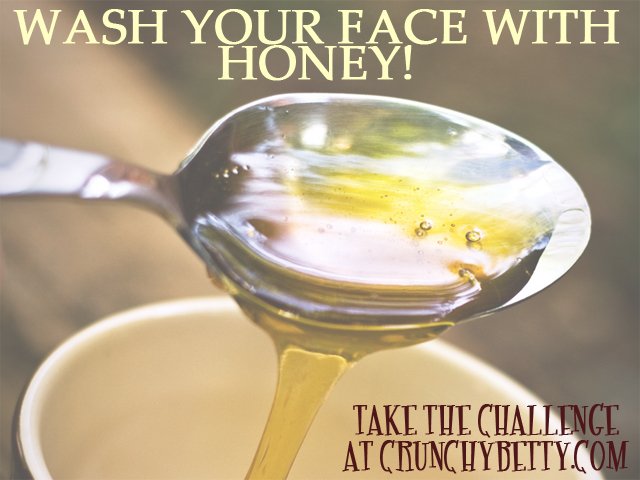
I am taking Crunchy Betty’s Honey Challenge. She is challenging us to clean our faces with honey.
This week I joined Crunchy Betty and others with a challenge to clean my face with honey.  You may be wondering why on earth would I use honey to clean my face. Well to be honest I wasn’t using anything but water. I have tried all sorts of facial cleansers over the years. But over the same years my skin has gotten more and more sensitive to the chemicals and fragrances in the cleansers. So I stopped using all commercial products. On the rare occasion that water did not seem like enough I would use a little Witch Hazel to clean followed up with some aloe. When I discovered this challenge I thought it was meant to be. I had just picked up some natural raw honey last week for my green tea.
Not only am I doing this challenge I have convinced my two girls to try it too.

So - Why honey?


Honey has been used for ages, archeologists have found honey in Egyptian pyramids.  Honey never goes bad, it may crystalize but it does not go bad. Additionally it :
  • is  antibacterial and antimicrobial? It will get off any lingering nastiness that’s thinking about setting up camp on your face and creating pimples.

  • is  slightly drying which means it helps soak up any pimples or oiliness
  • is incredibly moisturizing. Seems like a double standard, doesn’t it? But it’s true. Honey sinks into your skin and moisturizes like you wouldn’t believe. (Remember Cleopatra and her honey baths to look young?)
  • imparts all kinds of beneficial enzymes that work at scrubbing your face for you, as well as perform a little anti-aging action.
  • is great for acne, aging skin, normal skin, dry skin … honey loves EVERY SKIN TYPE.
  • is healing and helps repair acne sores and scars.


How to Wash your Face with Honey

  1. Tie your hair back or get it out of your face. (Honey makes hair really sticky.)
  2. Pour 1/2-ish teaspoon of honey into the palm of your hands and rub your hands together for 2-3 seconds, just to warm up the honey. If you add just a little bit of water, it makes a nice lather and is easier to spread.
  3. Place the honey on your face and massage it in for a minute or two – all around, don’t forget an inch of face.
  4. Optional – leave the honey sitting there on your face for 5 or 10 minutes, just so your skin can drink the goodness in. I like to leave it on until I feel my skin tightening like a good mask
  5. Rinse a few times with  warm water. You’ll be surprised at how quickly and easily it rinses off!

That’s it. Sounds easy doesn’t it? I am ready because I had given up on all facial cleansers, most of them included fragrance that irritated my skin.  So if you would like to join me here is the link  to Crunchy Betty. She has lots of information on the why and how of washing you face with honey.

Monday, July 18, 2011

Homemade Pore strips


This post was written by Green Teen, aka my Pi. She is my natural beauty guru here
Pore strips are very useful, but can be really expensive if used regularly. Here is a inexpensive and easy way to make them.

You will need:
1 tbsp. of milk. It doesn’t matter what grade.
1 tbsp. of unflavored gelatin (jello) Do NOT get flavored!!!
    Flavored contains dyes and it will dye your skin.
    Microwaveable cup or container
    Unused makeup or paint brush. A brush you will not miss.


      Poor 1 tbsp. of milk into your container/cup. Now add the unflavored gelatin. Stir until it looks nice and chunky. Put in the microwave for 10 seconds. After it is done check and make sure it looks gooey. Kind of like melted butter. Let it cool. Take brush and test it on the back of your hand. It should be warm. Not too hot. Not too cold. Apply anywhere you have oily or grimy skin. Let it dry for about 10 minutes. Then peal off. It might hurt a little. You can look at all the oil, sea bum, dirt, and dead skin. Bet it looks gross. Interesting, but gross.

      Enjoy your own inexpensive and easy pore strips!!!!

      LinkWithin

      Related Posts Plugin for WordPress, Blogger...
      Thanks for joining me here, if you enjoy what you see take a moment and join me you can, Subscribe by RSS Feed or find me on Twitter or Facebook and Pinterest